
Moscato Bianco Wine: Moscato d'Asti & Sweet Sparkling Whites
Moscato Bianco is the grape behind Moscato d'Asti — Piedmont's lightly sparkling, delicately sweet white that's become a go-to for dinner parties and gifts alike. Expect peach, orange blossom and fresh sage, a soft natural fizz, and a low 5-5.5% alcohol that makes it as easy to pour before dinner as after. Serve it well chilled (4-6°C) with fresh fruit, pastries or simply on its own — no expertise required, just good taste.


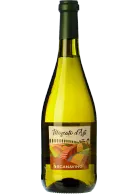
Moscato Bianco Wine: Moscato d'Asti & Sweet Sparkling Whites
Moscato Bianco is the grape behind Moscato d'Asti — Piedmont's lightly sparkling, delicately sweet white that's become a go-to for dinner parties and gifts alike. Expect peach, orange blossom and fresh sage, a soft natural fizz, and a low 5-5.5% alcohol that makes it as easy to pour before dinner as after. Serve it well chilled (4-6°C) with fresh fruit, pastries or simply on its own — no expertise required, just good taste.
Loved a glass of this on a trip to Piedmont, or after seeing it recommended on Wine-Searcher or by Robert Parker Wine Advocate? You're in the right place: this is the same wine, delivered to your door with £10 off your first order.
Moscato Bianco contributes to the production of Moscato d'Asti DOCG, a typical sweet sparkling Piedmontese wine produced by blocking the fermentation of the must in autoclaves and thus obtaining light froth, good residual sugar and low alcohol content, excellent as an aperitif or to accompany simple pastries, for example Christmas ones. Moscato bianco also excels as a passito, giving a more concentrated, mineral, enveloping product, although always with a nice almond return and intoxicating aromatic scents of flowers. This type is still excellent in Piedmont, in the Loazzolo DOC, and in Valle d’Aosta.
Excellent moscato bianco can also be found in Oltrepò Pavese, Alto Adige and Veneto, but it is also found in the central regions, where with a slight withering or late harvest it gives life to Moscadello di Montalcino, and in the south, with Moscato di Cagliari, Moscato molisano and Moscato pugliese, often called "royal", whose highest expression is probably the Moscato di Trani, as far as Sicily, where between Syracuse and Noto the Moscato bianco is withered with excellent results for iodine, saline, mineral and vegetable complexity, as well as for Mediterranean nectar concentration.
Moscato bianco, of course, can also be vinified dry, obtaining a wine of intense aroma, with sweet notes, but fresh, sapid and almond on the palate. An excellent example, in Lazio, is moscato di Terracina, which is probably a local adaptation of Moscato bianco and which, in turn, can also be subjected to withering with very convincing results.
FAQs
Is Moscato Bianco the same as Moscato d'Asti?
Moscato Bianco is the grape; Moscato d'Asti is the DOCG wine made from it in Piedmont — lightly sparkling and gently sweet, at a low 5-5.5% ABV.
How sweet is Moscato Bianco wine?
Most Moscato Bianco wines are sweet with fresh acidity to balance it, though dry versions exist (such as Moscato di Terracina). Sweetness and style are noted on each product page.
What's the difference between Moscato d'Asti and Asti Spumante?
Both come from the same grape and region. Moscato d'Asti is gently "frizzante" (semi-sparkling) and lower in alcohol; Asti Spumante is fully sparkling, closer in style to Prosecco.
What if my bottle arrives broken?
We replace it at no cost. Vinissimus insures every order and guarantees a replacement if a bottle is damaged in transit.
What food goes with Moscato Bianco?
Its sweetness and light fizz work well with fresh fruit, pastries, Christmas panettone-style bakes, and mild soft cheeses — or on its own as an aperitif.